Floating solar vs rooftop solar: when does each make sense?

Introduction
Solar PV can be deployed in three main forms: ground-mounted, rooftop, and floating. Each addresses a different combination of available surface, project scale, and consumption profile. Floating solar (FPV) is most often benchmarked against ground-mounted systems, since both are typically utility-scale and grid-connected. In practice, however, asset owners considering on-site generation may also compare FPV with rooftop options - particularly on industrial, port, and agricultural sites where both building surfaces and water bodies are available.
For these asset owners, rooftop and FPV are genuine alternatives. They can substitute for each other when capital or capacity constraints favour a single deployment, or be combined when the goal is to maximise on-site generation. The relevant question is therefore not which technology is universally better, but which one fits a specific site, scale, and operational profile - and whether deploying both makes sense for the same project.

Figure 1. Illustrative view of a port integrating both floating solar PV and rooftop solar installations, showing how the two technologies can complement each other to maximise on-site renewable electricity generation without additional land use. AI-generated image.
Site availability and surface use
Rooftop solar uses surfaces that already exist on buildings, with no additional land or water area required. This makes it attractive wherever the building stock is large and structurally suitable, particularly in commercial, industrial, and logistics sites with extensive roof areas.
FPV uses water surfaces - reservoirs, irrigation ponds, industrial basins, quarries, hydropower reservoirs, nearshore and offshore locations. For asset owners facing land scarcity or competing land uses, FPV opens otherwise unused surfaces. The World Bank has estimated the global technical potential of floating solar at around 400 GW under conservative assumptions, based on man-made freshwater bodies (World Bank Group, ESMAP and SERIS, Where Sun Meets Water, 2019).
Energy yield and performance
Rooftop yield depends on roof orientation, tilt, and any shading from surrounding structures or vegetation.
FPV generally benefits from lower module operating temperatures due to proximity to water, and from open exposure on the water surface. The magnitude of this cooling effect is real but varies considerably across sites and system configurations. Peer-reviewed studies report energy gains ranging from about 3% to 10% compared to equivalent ground-mounted systems, with Dörenkämper et al. (2021) reporting around 3% in the Netherlands and 6% in Singapore, and Tina et al. reporting 3.4% to 7.3% across other configurations. The actual uplift on a specific site depends on local climate, water temperature, module mounting, and float design, so the cooling effect should be assessed case by case rather than assumed as a fixed bonus.
Structural and engineering considerations
Rooftop projects rely on a relatively well-understood engineering envelope: structural assessment of the building, attachment and ballast design, fire safety, and roof access for installation and maintenance.
FPV introduces a different engineering scope: floating platform, connectors, mooring and anchoring, and the management of environmental loads such as wind, waves, and water-level variation. As discussed in our article on wind, waves, and water-level variation, these loads must be considered together and influence layout, structural concept, and long-term reliability.
Permitting and stakeholders
Rooftop solar usually involves building permits, with stakeholders typically limited to the building owner, the local authority, and the grid operator.
FPV permitting is broader. It typically involves water-use rights and may require an environmental impact assessment depending on the site and the regulatory regime. In some cases, consultation with navigation, fishing, or recreational users is also needed. This makes FPV development more sensitive to early site selection and stakeholder engagement, as also noted in recent IEA PVPS Task 13 guidance on floating-PV deployment.
Self-consumption and grid sales
Rooftop solar is mainly used for self-consumption: the building or site below uses the electricity directly, with any surplus fed to the grid.
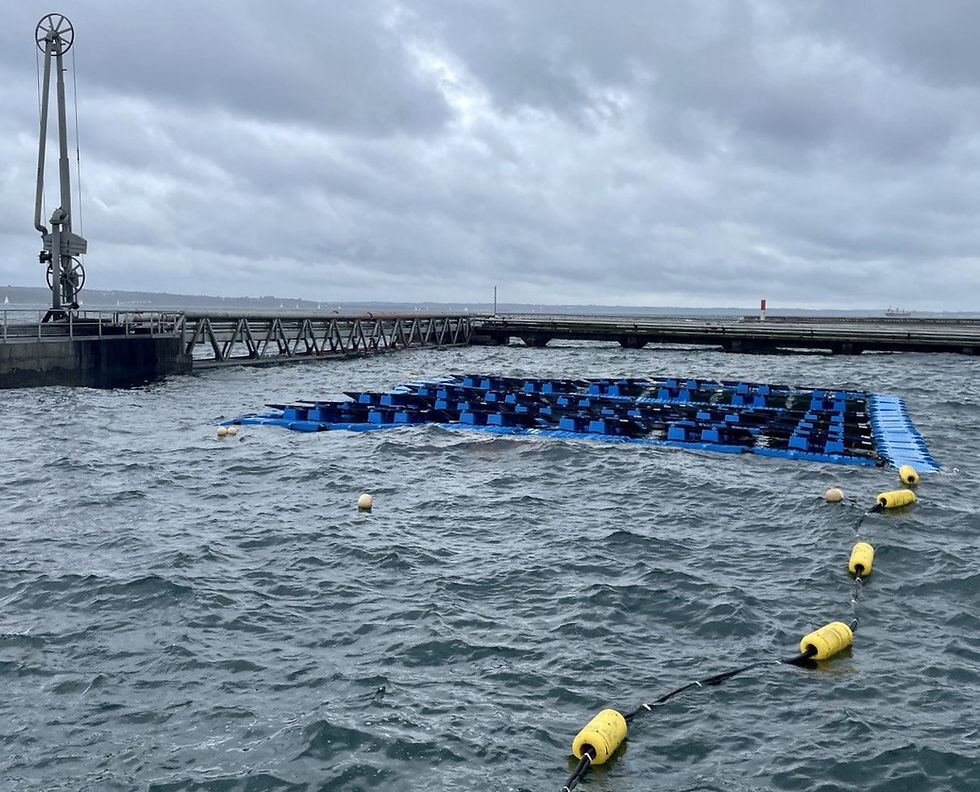
FPV covers a wider range of configurations. It can support self-consumption when the water-body operator has on-site demand - a port, an industrial site, a water utility, or an agricultural cooperative - with any surplus sold to neighbouring users or to the grid. HelioRec's 250kWp installation at Domaine de Cicé-Blossac in Rennes is one example: a floating solar plant supplying a restaurant and a hotel directly for self-consumption. FPV is also widely used for utility-scale projects of several MW or more, where the electricity is primarily sold to the grid under the applicable national framework.
Cost considerations
At comparable scale, FPV and rooftop solar are broadly in the same cost range of 600-800 euros/kWp. However, the site-specific drivers usually matter more than the technology choice itself: rooftop costs are sensitive to roof condition, structural reinforcement needs (which alone can increase cost of the project by 50-70%), and access constraints, while FPV costs are sensitive to water depth, water-level variation, mooring and anchoring requirements. Each project should therefore be assessed on its own engineering and logistical envelope.
When each solar installation makes sense
Rooftop solar is generally a good fit when there is a building with enough usable roof area and the electricity can be used on site. Permitting is usually simpler, and project size is limited by the roof itself.
Floating solar is generally a good fit when there is access to a water body - a reservoir, irrigation pond, quarry, or water areas of the port - and either more capacity is needed than a roof can deliver, or the land needs to stay free for its main use (farming, port operations, logistics). The water-body owner can use the electricity on site, or sell any surplus to neighbouring users or to the grid. Floating solar is also widely deployed at utility scale, with multi-MW plants on large reservoirs and hydropower assets where the electricity is sold directly to the grid.
The two can also be deployed in parallel on the same site. Rooftop projects often cannot cover all of a site's electricity needs and clients frequently look for additional surfaces to install more solar capacity. For industrial and agricultural operators with both buildings and water assets, combining rooftop and floating solar is a way to scale up on-site generation without expanding the land footprint. From this perspective, FPV does not replace rooftop solar; it extends the surface available for PV beyond what built infrastructure alone can provide.
Practical checklist
General questions:
What is the primary purpose of the installation: self-consumption, sale to neighbouring users, or sale to the grid?
What generation capacity is needed?
Rooftop option:
What is the available roof area, orientation, structural capacity, and access for installation and maintenance?
Is structural reinforcement of the roof needed?
What building permits and fire-safety requirements apply?
Floating solar option:
What type of water body is involved (lake, reservoir, industrial basin, port area), and what are its depth, water-level variation, and exposure to wind, waves, and current?
What shoreline access exists for assembly, installation, and ongoing O&M?
What environmental, water-use, and permitting constraints apply?
FAQs
Is floating solar more expensive than rooftop solar? Not necessarily. At comparable scale, the two technologies fall in similar cost ranges (600-800 euros/kWp). The main drivers are site-specific: roof condition and access for rooftop projects, and water depth, mooring requirements, and electrical layout for floating projects.
Can rooftop and floating solar be combined on the same site? Yes. Industrial, port, or agricultural sites can deploy both to maximise on-site generation without expanding their land footprint.
Does floating solar always produce more energy per kWp than rooftop? Generally yes, FPV can benefit from cooler module temperatures and reduced shading, but the actual difference depends on local climate, water body characteristics, and rooftop conditions. Peer-reviewed studies report cooling-related yield uplifts of roughly 3-10%, varying by site.
HelioRec designs, manufactures, and deploys floating solar systems for both inland and marine nearshore environments. To discuss whether floating solar is suited to your site, contact us.