SOLEIAU: Advancing Floating Solar Through Physical Testing and Digital-Twin Technology
Introduction
HelioRec is proud to announce the launch of SOLEIAU, a three-year collaborative innovation project dedicated to advancing floating solar technology for coastal and other demanding water environments.
SOLEIAU - Modélisation et déploiement de l’énergie solaire flottante sur le littoral français- has been selected for support under the France 2030 “Projets collaboratifs i-Démo régionalisés” programme, operated by Bpifrance.
With a total project budget of approximately €1.13 million, SOLEIAU will run from 1 September 2026 to 1 September 2029.
The project brings together a complementary French consortium:
HelioRec, project coordinator and developer of floating solar technology
Centrale Nantes, through its recognised expertise in hydrodynamics, marine engineering and experimental testing
deepmath, specialising in advanced mathematical modelling, simulation and data-driven engineering
Together, the partners will combine physical testing, numerical modelling and digital-twin technology to improve the design, reliability and scalability of floating solar power plants.

The Challenge: How Can Floating Solar Expand Beyond Calm Inland Waters?
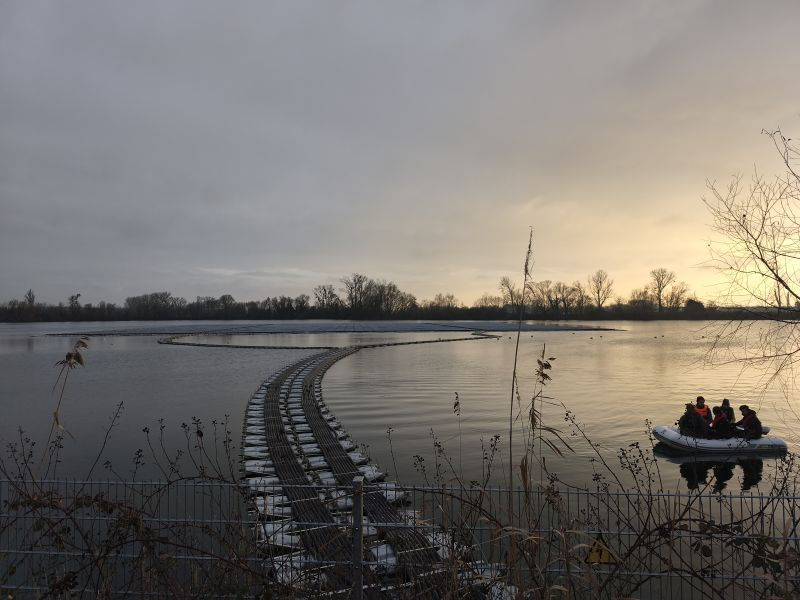
Most floating photovoltaic systems operating today are installed on relatively calm inland water bodies, such as reservoirs, lakes and industrial ponds.
However, the potential market for floating solar extends far beyond these locations. Ports, coastal areas and other exposed water surfaces offer significant opportunities for renewable electricity generation without using valuable land.
These environments also create more complex engineering challenges. A floating solar power plant may be exposed to:
Waves and changing sea states
Strong and multidirectional winds
Currents and tidal variations
Repeated dynamic loads
Structural movement and fatigue
Saltwater exposure and corrosion
Complex interactions between floaters, connectors and mooring systems
These loads do not act independently. Wind, waves and currents can occur simultaneously and create complex forces throughout the floating structure.
Reliable floating solar therefore requires more than designing individual components to withstand a single maximum load. Engineers must understand how the complete system behaves over time and how forces are transferred across the platform under different environmental conditions.
SOLEIAU has been created to address this challenge.
Introducing SOLEIAU
Solar4Ports is a 24-month project dedicated to developing, installing and operating a 200 kWp floating photovoltaic demonstrator in one of France’s largest ports.
The installation will use HelioRec’s W300A floating solar technology, developed specifically for coastal, nearshore and port environments.
Unlike a small experimental prototype, the Solar4Ports demonstrator will operate at a scale capable of providing meaningful technical, operational and commercial data. It will allow HelioRec and its partners to evaluate how a coastal FPV system performs under real port conditions.
The project will cover the complete development process, including:
Site analysis and technical engineering
Bathymetric and environmental studies
Permitting and administrative procedures
Structural and hydrodynamic assessments
Mooring system design
Electrical system integration
Grid connection
Manufacturing and installation
Monitoring, operation and maintenance
Performance analysis and operational feedback
The final configuration and exact installation area will be determined following detailed studies of water depth, waves, port activities, environmental constraints, grid access and navigational requirements.
From Physical Testing to Digital Models
Hydrodynamic Testing
Floating structures move continuously under the action of waves and currents. Even relatively small movements can generate repeated loads in floaters, connectors, mooring lines and other structural components.
Testing in controlled wave conditions will help the consortium observe:
Platform motion under different sea states
Load distribution across the floating structure
Interaction between individual floating modules
The effect of wave direction and frequency
Critical structural responses
Potential fatigue mechanisms
These experiments will provide essential data for evaluating the floating system’s behaviour and validating numerical models.
Aerodynamic Testing
Wind represents another major design load for floating photovoltaic systems.
Solar panels create large exposed surfaces, while their angle and arrangement influence the aerodynamic forces transferred to the floating platform and mooring system.
SOLEIAU will include advanced aerodynamic studies to better understand:
Wind pressure on solar panels and floating structures
Lift, drag and overturning effects
The influence of panel inclination
Loads created by different wind directions
Interactions between multiple rows of solar panels
The distribution of wind forces across a complete floating platform
The results will support the optimisation of system geometry and help engineers identify the most critical load combinations.
Building a Digital Twin for Floating Solar
One of SOLEIAU’s key innovations will be the development of an advanced digital representation of the floating solar system.
A digital twin is more than a three-dimensional model. It brings together physical characteristics, environmental conditions, simulation results and measured data to reproduce how a real system behaves.
Within SOLEIAU, the digital-twin approach is expected to support:
Simulation of wind, wave and current conditions
Prediction of platform movement and structural loads
Comparison between numerical results and physical testing
Identification of critical components and load cases
Optimisation of floating-platform configurations
Preparation of future commercial projects
Progressive integration of operational monitoring data
The digital twin will make it possible to test a wider range of environmental scenarios than could be reproduced through physical experiments alone.
This is particularly important for coastal floating solar, where every site has a different combination of water depth, waves, wind, currents, tides and operational constraints.
The SOLEIAU Consortium
SOLEIAU combines industrial technology development, academic expertise and advanced numerical engineering.
HelioRec
HelioRec coordinates the SOLEIAU project and contributes its experience in developing, manufacturing and deploying floating solar systems.
The company’s role includes the development and optimisation of the floating platform, coordination of technical activities, definition of representative environmental and operational conditions, and preparation of the technology for future commercial deployment.
HelioRec’s W300A technology is being engineered for challenging conditions that may include waves of up to four metres, winds of up to 200 km/h, tidal variations, currents and long-term saltwater exposure.
Centrale Nantes
Centrale Nantes contributes recognised expertise in hydrodynamics, marine engineering, numerical modelling and experimental testing.
Its involvement will help characterise the behaviour of the floating solar platform under representative wave conditions and provide high-quality experimental data for validating the project’s numerical models.
This academic and scientific contribution is essential for establishing a robust link between engineering assumptions, controlled testing and real structural behaviour.
deepmath
deepmath brings expertise in mathematical modelling, high-performance computing and data-driven engineering.
Its contribution supports the development, calibration and analysis of advanced simulation models. These tools will help the consortium conduct parametric studies, compare multiple system configurations and build the foundations of the SOLEIAU digital twin.
By connecting numerical simulation with experimental data, deepmath will contribute to transforming complex engineering results into practical design and optimisation tools.
What Will SOLEIAU Deliver?
Over its three-year duration, SOLEIAU aims to produce a validated engineering methodology for floating solar systems operating in demanding environments.
The project is expected to contribute to:
A better understanding of combined hydrodynamic and aerodynamic loads
Validated numerical models of the floating solar platform
Physical test data under controlled wind and wave conditions
A digital-twin framework for system analysis and optimisation
Improved design rules for floaters, connections and mooring interfaces
More efficient evaluation of new floating solar sites
Reduced technical uncertainty during project development
Stronger evidence for technical advisers, insurers, investors and project owners
Preparation for larger coastal and nearshore floating solar power plants
The project will also help reduce the time and cost required to assess different platform configurations and environmental conditions.
Improving Reliability and Bankability
Floating solar projects must demonstrate that they can operate safely and reliably throughout their intended service life.
For coastal projects, this requires a detailed understanding of both extreme events and the repeated lower-level loads that can cause fatigue over time.
By combining controlled testing and digital modelling, SOLEIAU will help address some of the main questions considered by project developers and financial stakeholders:
How will the platform behave during severe wind and wave conditions?
Where will the highest mechanical loads occur?
How will repeated movements affect the system over time?
How should the platform and mooring system be adapted to a particular site?
How can engineers evaluate new configurations before manufacturing and installation?
Which parameters should be monitored during operation?
Answering these questions is essential for improving the bankability of coastal floating solar projects and creating confidence among ports, energy companies, investors, insurers and independent technical advisers.
Supporting the Development of French Floating Solar Technology
France has strong capabilities in maritime engineering, renewable energy, numerical simulation and scientific research.
SOLEIAU brings these capabilities together around an emerging clean-energy technology with significant international potential.
The project will support several strategic objectives:
Accelerating renewable-energy innovation
Developing French expertise in coastal floating solar
Strengthening cooperation between industry and academic research
Improving the reliability of floating renewable-energy infrastructure
Reducing the use of valuable land for energy generation
Preparing scalable solutions for ports and coastal territories
Supporting the international competitiveness of French clean-technology companies
SOLEIAU has also received the Smart Power label, recognising its contribution to energy innovation and the development of more intelligent and sustainable power systems.
From Engineering Validation to Commercial Deployment
SOLEIAU is an important part of HelioRec’s development pathway for coastal floating solar.
The project will build on HelioRec’s previous experience with floating solar installations in inland and marine environments while addressing the advanced modelling and validation required for larger commercial projects.
The knowledge generated through SOLEIAU will support a progressive approach:
Characterise the environmental loads affecting the system.
Test the floating platform under controlled conditions.
Validate numerical and digital models against physical results.
Optimise structural and floating-platform configurations.
Apply the methodology to future coastal sites.
Scale the technology towards larger commercial installations.
This approach will help transform floating solar from a site-specific engineering solution into a more standardised, predictable and scalable energy infrastructure.
Acknowledgement
HelioRec gratefully acknowledges the support of France 2030, Bpifrance and the regional i-Démo programme.
We also thank our consortium partners, Centrale Nantes and deepmath, for bringing together the scientific, industrial and digital expertise needed to advance the next generation of floating solar technology.
HelioRec designs, manufactures and deploys floating solar systems for inland, port, coastal and nearshore environments.
HelioRec designs and deploys floating solar systems for inland, port, coastal and nearshore environments.
HelioRec designs, manufactures, and deploys floating solar systems for both inland and marine nearshore environments. To discuss whether floating solar is suited to your site, *contact us