
ERM Independent Due Diligence: How HelioRec's W300A Floating Solar Technology Is Building a More Bankable Future for nearshore FPV
Introduction
As the global floating solar market evolves, investors are increasingly asking a critical question: Can floating solar technology developed for harsh marine environments be considered bankable?
For many early-stage technologies, obtaining an independent third-party review is a major milestone. It provides objective evidence of technical robustness, identifies remaining risks, and creates a clear roadmap toward commercial deployment.
HelioRec recently achieved such a milestone. Its W300A floating solar technology, designed specifically for nearshore and port applications, underwent an independent technical due diligence performed by ERM (Environmental Resources Management) with support from the EIB (European Investment Bank) under the SunHarbor project.
The findings are encouraging: ERM recognised several innovative aspects of the W300A design and assigned positive ratings to key components of the system. At the same time, the review identified additional validation activities that are typical for emerging hardware technologies moving toward large-scale commercialisation.
The report did not identify fundamental barriers to deployment. Instead, it confirmed that the remaining work is focused primarily on expanding the evidence base through larger pilots and long-term operational data.

Why Independent Due Diligence Matters for Floating Solar Projects
As floating solar power plants move beyond protected reservoirs into ports, industrial basins, estuaries, and coastal waters, the engineering challenges become significantly more complex.
Unlike conventional inland FPV systems, nearshore projects must withstand:
Saltwater exposure and corrosion;
Strong winds;
Multidirectional wave loading;
Tidal variations;
Mechanical fatigue over decades of operation;
Increased complexity associated with larger floating arrays.
Independent due diligence helps developers, investors, and lenders understand whether a new floating photovoltaic system can realistically address these challenges.
The European Investment Bank's Role
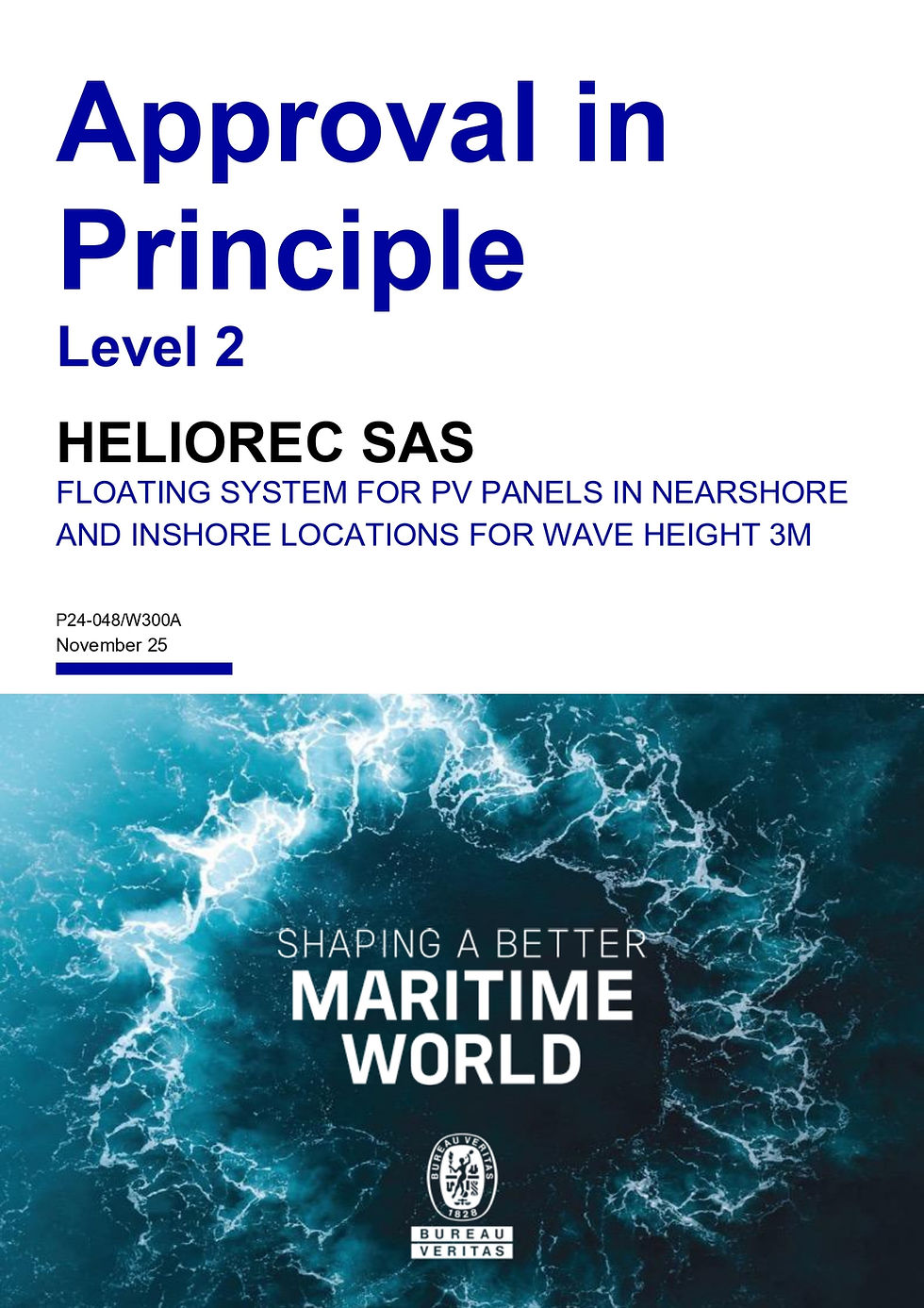
The due diligence was conducted within the framework of the SunHarbor project, supported by the European Investment Bank (EIB).
The EIB is the financing institution of the European Union and one of the world's largest multilateral lenders dedicated to climate action, innovation, and sustainable infrastructure.
Its support demonstrates growing institutional interest in accelerating the deployment of innovative floating solar technology capable of unlocking renewable energy opportunities in ports and coastal environments.
Who Is ERM?
ERM (Environmental Resources Management) is one of the world's leading sustainability consulting firms, employing more than 8,000 experts across over 40 countries.
ERM regularly advises:
Global energy companies;
Infrastructure developers;
Financial institutions;
Investment funds;
Governments;
Industrial clients.
Its technical due diligence reports are widely used to support financing decisions involving complex infrastructure projects.
For the SunHarbor project, ERM reviewed HelioRec's documentation, performed independent assessments, benchmarked the technology against industry practice, and evaluated the technical risks associated with the W300A design.
The Problem with Conventional Floating Solar Technology
Today's floating solar panels were primarily developed for calm inland waters.
Most commercial systems rely on rigidly interconnected HDPE pontoons.
While effective in reservoirs, these designs become increasingly challenged as projects scale or move into more dynamic environments.
ERM noted that the wider FPV industry still faces unresolved issues including:
Wave-induced motion;
Fatigue accumulation;
Corrosion;
Large-array modelling;
Structural scalability.
As arrays become larger, loads accumulate through rigid connections, increasing stress concentrations and potentially reducing long-term reliability.
How W300A Reinvents Floating Solar for Nearshore Applications
According to ERM: "The W300A concept is fundamentally novel because it decouples global load transfer from the floaters themselves."
Rather than forcing rigid pontoons to transfer environmental loads throughout the array, the W300A separates structural functions.
The system combines:
Twin-sheet thermoformed HDPE floaters;
A distributed websling network;
Flexible dampers;
Modular rafts;
Compliant inter-module connections;
Diagonal tensile load paths.
The floaters primarily provide buoyancy, while the sling system transfers environmental loads.
ERM concluded that this architecture directly addresses one of the core structural challenges associated with scaling floating solar power plants.
Components That Received Positive ("Green") Ratings
One of the strongest outcomes of the review was the positive assessment of several key components.
1. Modular Floating Foundation Architecture
ERM assigned a green rating to the overall floating foundation concept.
The W300A array consists of:
Main floaters;
Dampers;
Small rafts;
Webslings;
Connectors;
Linking tubes;
Solar panel supports.
ERM commented: "This is a modular approach... It also enables replacement of local components when required."
According to the review, this approach offers several advantages:
✓ Flexible sizing based on project requirements;
✓ Adaptation to different floating solar power plant capacities;
✓ Efficient maintenance through replacement of individual components;
✓ Improved operational flexibility;
✓ Simplified logistics and installation.
For investors, modularity contributes to lower lifecycle risk and improved maintainability.
2. Green Rating for the W300A Floater
ERM also positively assessed the main W300A floater itself.
The review noted that each floater:
Is manufactured using twin-sheet thermoformed HDPE;
Measures 1.9 m × 1.3 m × 0.24 m;
Weighs approximately 27 kg;
Provides approximately 334 kg of buoyancy;
Supports one solar panel under operational and survivability conditions;
Can safely accommodate maintenance personnel;
Can be handled manually by two people.
Importantly, ERM highlighted the diagonal sling arrangement as a major innovation : "The diagonal mesh forms an 'X' arrangement which helps the product to handle wave loading from multiple directions."
ERM noted that this represents an improvement over many existing systems originally designed for predominantly unidirectional loading conditions.
3. Flexible Connections Inspired by Offshore Engineering
ERM observed that conventional FPV systems typically rely on rigid hinges, pins, or mechanical interlocks.
By contrast, W300A intentionally allows controlled movement between modules.
According to ERM: "Soft connections can reduce fatigue and accommodate wave-induced motion more effectively than rigid joints."
The reviewers described this behaviour as a meaningful shift toward offshore-adapted floating solar technology.
4. Practical Operations and Maintenance Strategy
ERM also positively reviewed HelioRec's O&M approach.
The report stated: "The inspection requirements and intervals seem sensible."
ERM particularly welcomed:
✓ Immediate corrective actions if anchor movement is detected;
✓ Regular inspection intervals;
✓ Additional inspections following severe storms.
These recommendations align with best practices for marine infrastructure.
Validation Already Performed
The review acknowledged that HelioRec has continuously improved its technology through iterative development.
Previous demonstration campaigns in the Port of Brest provided valuable lessons regarding:
Site-specific environmental loading;
Manufacturing quality control;
Installation procedures;
Acceptance testing;
Operational practices.
ERM recognised that this learning process contributed significantly to the evolution of the W300A design.
What Still Needs to Be Improved?
Importantly, the remaining recommendations do not represent fundamental weaknesses.
Instead, they outline the natural next steps toward strengthening the bankability of the technology.
1. Scaling Validation
ERM recommended expanding the evidence demonstrating how the system behaves when moving from kilowatt-scale pilots to multi-megawatt floating solar power plants.
The report advised providing:
Hydrodynamic scaling analyses;
Large-array simulations;
Verification of load distribution.
ERM specifically recognised HelioRec's planned 200 kWp pilot in the Port of Brest as: "an ideal test project scale."
2. W300A Operational Data
Previous Brest demonstrators used earlier W200 variants.
ERM noted that these campaigns generated valuable lessons but are not direct proof of W300A durability.
Additional operational data generated specifically using W300A installations will further strengthen investor confidence.
3. Extreme Survivability Assessment
ERM recommended continued validation under representative marine conditions, including:
Extreme wave events;
High wind conditions;
Combined environmental loading;
Long-term fatigue effects.
The report emphasised that wave loads can be significantly more severe than wind loads in marine environments.
4. Damper Testing
ERM identified the damper as a critical component influencing survivability.
The reviewers recommended:
Additional buckling analyses;
Further finite element assessments;
Physical testing of damper components.
These recommendations aim to expand the validation evidence rather than redesign the underlying concept.
5. Long-Term Material Durability
ERM also highlighted the importance of understanding combined environmental degradation, including:
UV exposure;
Saltwater corrosion;
Biofouling;
Mechanical fatigue;
Material ageing.
The report noted that combined degradation mechanisms can sometimes be more severe than individual effects considered separately.
6. Monitoring of Dyneema and Fire Mitigation
Additional recommendations included monitoring:
Dyneema creep and fatigue behaviour;
Protective measures against sling wear;
Fire mitigation associated with HDPE structures and electrical systems.
These considerations are common across marine infrastructure projects and represent opportunities for further optimisation.
Building the Next Generation of Bankable Floating Solar
The future of floating solar lies beyond reservoirs. Ports, industrial basins, and coastal waters represent one of the largest untapped opportunities for renewable energy deployment, but they require technologies specifically designed for these environments.
The independent review performed by ERM and supported by the European Investment Bank represents an important milestone in HelioRec's journey toward delivering bankable nearshore floating solar technology.
The W300A has already undergone rigorous third-party scrutiny from one of the world's leading technical due diligence firms. The remaining steps focus on expanding operational evidence through larger deployments and long-term monitoring - not addressing fundamental flaws in the technology itself.
As demand for resilient, scalable, and cost-effective FPV systems continues to grow, combining innovation with transparent independent validation will be essential.
The ERM review suggests that HelioRec's W300A is well positioned to become part of the next generation of floating solar power plants designed for the realities of the marine environment.
HelioRec designs, manufactures, and deploys floating solar systems for both inland and marine nearshore environments. To discuss whether floating solar is suited to your site, *contact us


Comments