
What Makes a Floating Solar System Bankable?
- HelioRec Company

- Jun 10
- 7 min read
Introduction
As the global market for floating solar continues to expand, investors, utilities, ports, and industrial players are increasingly asking the same question: what makes a floating solar project truly bankable?
While the potential of floating solar technology is undeniable, not all projects are created equal. A bankable floating solar power plant is one that gives confidence to investors, lenders, insurers, and project developers that it can operate safely, generate the expected energy output, and deliver predictable financial returns throughout its lifetime.
In this article, we explore the key factors that determine whether an FPV (Floating Photovoltaic) project can attract financing and move from concept to commercial reality.

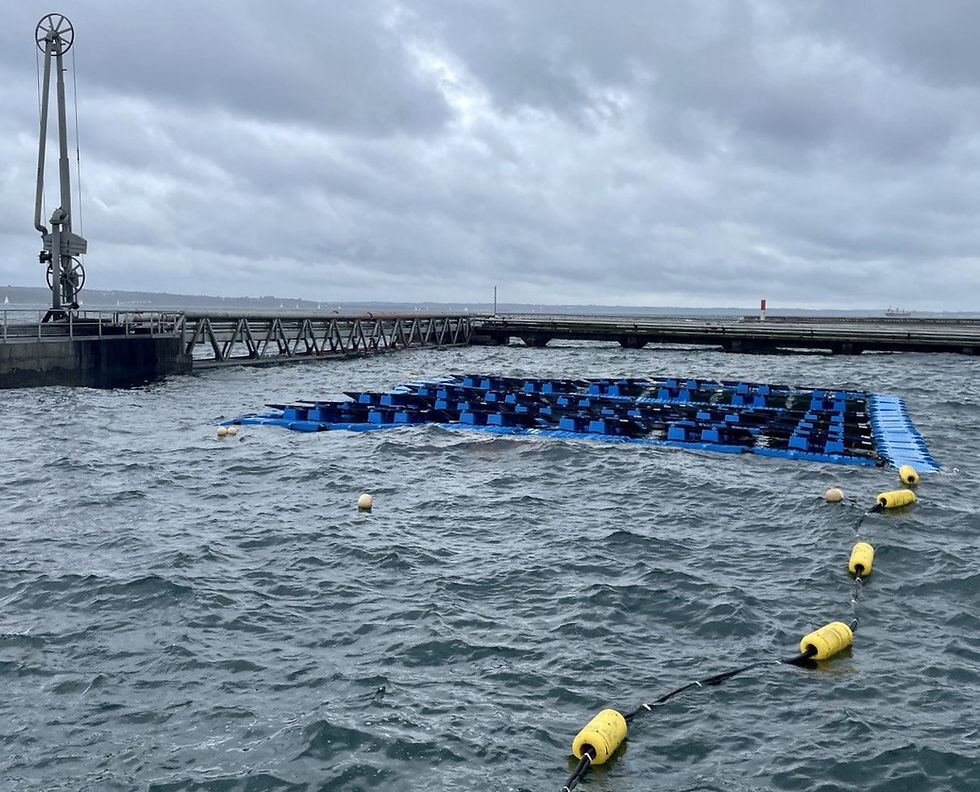
Figure 1. Illustrative view of the floating solar power plant in Brest port with W300A floating solar technology. AI-generated image.
What Does "Bankability" Mean in Floating Solar?
Bankability refers to the level of confidence that financial institutions and investors have in a project's ability to repay debt and generate stable returns.
For a floating solar power plant, bankability depends on reducing technical, operational, environmental, and financial risks.
The more uncertainties are addressed during project development, the easier it becomes to secure funding, insurance coverage, and stakeholder support.
1. Proven Floating Solar Technology
One of the first questions investors ask is simple:
Has this floating solar technology been demonstrated under real operating conditions, and at a scale large enough to provide meaningful operational evidence? While there is no universal threshold, investors generally place greater confidence in technologies that have been deployed in commercial projects of several megawatts. Demonstrations in the range of 5–10 MW or more, operating successfully over multiple years and under conditions comparable to the proposed site, can significantly strengthen the bankability case.
New technologies often face skepticism because of limited operational history. Developers should therefore provide evidence such as:
Existing commercial references;
Long-term operational data;
Performance monitoring results;
Independent testing reports;
Lessons learned from previous installations.
Demonstrating successful deployment of floating solar panels in comparable environmental conditions significantly reduces perceived risk.
2. Independent Certification and Third-Party Validation
Independent verification plays a major role in project financing.
Certification bodies can assess whether a floating structure has been designed according to recognised engineering practices and safety principles.
Examples include:
Approval in Principle (AiP);
Structural assessments;
Material qualification;
Compliance with industry recommendations;
Third-party design reviews.
For emerging floating solar technology, these assessments provide an additional layer of confidence to lenders and insurers.
3. Site-Specific Engineering
Unlike conventional ground-mounted PV systems, every FPV project interacts continuously with its environment.
A design suitable for a calm reservoir may fail in coastal conditions.
Bankable projects therefore require thorough site investigations, including:
Environmental Data Collection
Wind characteristics;
Wave conditions;
Water level fluctuations;
Current velocities;
Bathymetry;
Ice and snow loads where applicable.
Engineering Studies
Mooring and anchoring analysis;
Structural calculations;
Hydrodynamic simulations;
Fatigue assessments;
Electrical system design.
Site-specific engineering ensures that the floating solar power plant is optimised for its actual operating environment rather than relying on generic assumptions.
4. Reliable Energy Yield Assessment
Revenue ultimately depends on electricity production.
Financial institutions therefore expect realistic estimates of annual energy generation.
Key considerations include:
Solar irradiation data;
Module selection;
System losses;
Soiling assumptions;
Availability assumptions;
Degradation rates;
Effects of module cooling from water.
Because floating solar panels often operate at lower temperatures than land-based systems, they can benefit from improved efficiency. However, these gains should be supported by credible assumptions rather than optimistic marketing claims.
5. Understanding Floating Solar Cost
One of the most common questions from project owners is: What is the floating solar cost?
The answer depends on multiple factors, including:
Site conditions;
Project size;
Anchoring strategy;
Distance to the electrical connection point;
Environmental constraints;
Local labour costs;
Installation methodology.
Focusing solely on upfront CAPEX can be misleading. Bankable projects evaluate the complete financial picture:
Capital expenditure (CAPEX);
Operational expenditure (OPEX);
Maintenance requirements;
Insurance costs;
Replacement strategies;
Expected project lifetime.
The objective is to optimise the Levelized Cost of Electricity (LCOE), rather than simply minimising initial investment. Nowadays, floating solar projects are increasingly expected to achieve cost competitiveness comparable to ground-mounted and rooftop solar installations. Meeting these expectations can be particularly challenging in demanding water environments, where harsher wind, wave, current, or tidal conditions require more robust engineering solutions and can influence overall project economics.
6. A Robust Supply Chain
Investors also evaluate whether the project can actually be delivered.
Questions often include:
Are critical components sourced from reliable manufacturers?
Are lead times realistic?
Is manufacturing capacity secured?
Are alternative suppliers available?
Is quality control implemented?
A resilient supply chain reduces the risk of delays and cost overruns that can negatively affect project economics.
7. Clear Operation and Maintenance Strategy
A floating solar power plant is expected to operate for 25 years or more.
Developers should therefore define:
Inspection schedules;
Cleaning procedures;
Monitoring systems;
Preventive maintenance activities;
Spare parts strategies;
Emergency response procedures.
A well-structured O&M plan improves system availability and provides confidence that projected energy yields can be achieved throughout the asset's life.
8. Insurance and Risk Allocation
Not all insurers are willing to underwrite floating solar projects, particularly those located in marine environments where exposure to waves, currents, corrosion, storms, and other offshore risks can increase uncertainty. As a result, obtaining suitable insurance coverage can be more challenging than for conventional ground-mounted PV systems, and the availability and terms of coverage may vary significantly between markets.
Insurance costs should therefore be considered carefully during project development. Depending on the project's location, risk profile, and insurer appetite, annual insurance premiums can range from approximately 3% to 5% of the total CAPEX of a floating solar power plant. These costs can have a meaningful impact on the overall economics and bankability of an FPV project and should be incorporated into financial models from an early stage.
Appropriate insurance coverage is another important indicator of bankability.
Typical policies may include:
Construction all-risk insurance;
Third-party liability insurance;
Marine insurance where relevant;
Operational insurance;
Business interruption coverage.
Equally important is the allocation of responsibilities between stakeholders.
Contracts should clearly define who is responsible for:
Engineering;
Procurement;
Installation;
Commissioning;
Operation and maintenance;
Performance guarantees.
Transparent risk allocation reduces uncertainty and facilitates financing.
9. Revenue Visibility
Even the best-designed FPV system requires a predictable source of income.
Common revenue structures include:
Corporate Power Purchase Agreements (PPAs): Under a corporate PPA, the electricity generated by the floating solar power plant is sold directly to a private company through a long-term contract, typically ranging from 10 to 20 years. This model provides predictable revenues and can be particularly attractive for industrial facilities, ports, logistics hubs, and large commercial consumers seeking to reduce their carbon footprint while securing stable electricity prices. In Europe, corporate PPAs have grown rapidly as companies pursue decarbonisation targets and seek protection against energy market volatility.
Utility PPAs: In this model, electricity is sold to a utility company or energy supplier under a negotiated agreement. Utility PPAs often support large-scale projects and can offer strong revenue certainty when backed by creditworthy counterparties. However, pricing conditions depend heavily on national market structures and utility procurement strategies.
Self-consumption models: The electricity generated is primarily used on-site by the asset owner or a nearby electricity consumer, reducing the amount of power purchased from the grid. This approach is particularly relevant for water treatment plants, industrial sites, ports, and commercial facilities with significant daytime electricity demand. Self-consumption can substantially improve project economics by offsetting retail electricity prices, which are often higher than wholesale market prices.
Surplus export models: When generation exceeds on-site consumption, excess electricity is exported to the grid and sold through market mechanisms, fixed tariffs, or separate agreements. Combining self-consumption with surplus export allows project owners to maximise the value of the electricity produced while maintaining flexibility as consumption patterns evolve.
Feed-in tariffs: Under a feed-in tariff scheme, all or part of the electricity generated is sold to the grid at a predefined price established by regulators. While this model historically played a major role in accelerating renewable energy deployment across Europe, many countries have reduced or phased out generous feed-in tariffs in favour of more market-based mechanisms.
Hybrid business models: These approaches combine several revenue streams, such as self-consumption, surplus export, corporate PPAs, participation in electricity markets, or storage integration. Hybrid structures can improve resilience against changing market conditions and optimise project profitability.
Across Europe, there is no single business model that fits every floating solar project. However, self-consumption combined with surplus export is increasingly considered one of the most attractive options due to high retail electricity prices and the ability to maximise the value of generated power. Corporate PPAs are also becoming a preferred solution, particularly for large industrial consumers seeking long-term price stability and supporting sustainability commitments. The optimal model ultimately depends on local regulations, electricity prices, grid access conditions, and the electricity consumption profile of the end user.
In France, the economics of solar projects increasingly favour self-consumption. Electricity purchased from the grid typically costs businesses around €0.15 to €0.25 per kWh, depending on the contract and consumption profile. This means that every kilowatt-hour produced and consumed on-site can generate significant savings. By contrast, the remuneration for surplus electricity injected into the grid has declined considerably in recent years, with feed-in tariffs for larger installations often ranging between approximately €0.04 and €0.06 per kWh. As a result, for many commercial and industrial solar projects, self-consumption has become the most attractive and practical option, while selling electricity to the grid generally offers more limited financial benefits.
Long-term revenue certainty remains one of the strongest contributors to project bankability.
Practical Checklist
Before approaching investors or lenders, ask yourself:
Has the technology been demonstrated in similar environments?
Are independent certifications or third-party reviews available?
Have site-specific engineering studies been completed?
Is the energy yield assessment realistic?
Is the total floating solar cost understood over the full project lifetime?
Is the supply chain secure?
Is there a clear O&M strategy?
Are insurance requirements addressed?
Is the revenue model robust and predictable?
The more boxes you can tick, the stronger your project's investment case becomes.
FAQs
Is floating solar bankable today? - Yes. The global floating solar market has matured significantly over the past decade. Projects are increasingly financed by commercial lenders, provided that technical and financial risks are appropriately managed.
Are floating solar panels more expensive than ground-mounted PV? - In many cases, initial investment costs are higher due to floating structures and mooring systems. However, the ability to utilise unused water surfaces and achieve attractive electricity production can make floating solar cost competitive over the project's lifetime.
Why is certification important for FPV projects? - Independent certification provides confidence that the design has undergone rigorous review, helping investors, insurers, and project owners assess project risk.
What is the biggest challenge for floating solar technology? - There is no universal design suitable for every site. Successful projects rely on adapting the technology to local environmental conditions through robust engineering.
HelioRec designs, manufactures, and deploys floating solar systems for both inland and marine nearshore environments. To discuss whether floating solar is suited to your site, *contact us


A friend recommended Drive Mad, and I can see why. Some stages look easy at first, but they require surprisingly careful control.