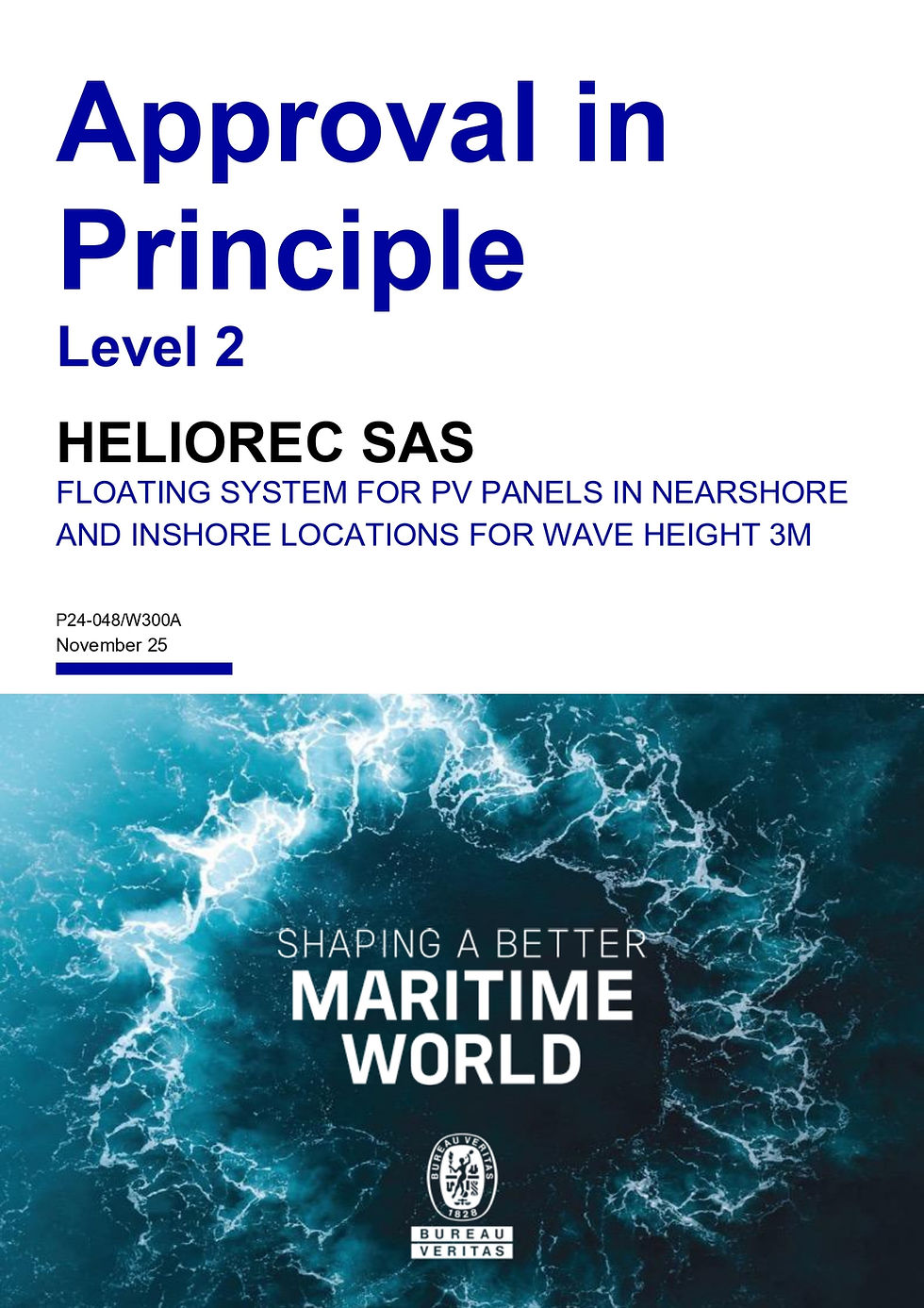
W300A Floating Solar in Brest: Generating Clean Energy and Real Marine Data
Introduction
In 2026, HelioRec deployed its next-generation W300A floating solar system in Brest Port, France, creating a 10 kWp demonstrator specifically designed for nearshore and marine environments.
The installation represents an important step in the development of floating solar technology for locations where conventional inland FPV systems face much more demanding conditions. In Brest, the platform operates in a tidal marine environment exposed to waves, wind, saltwater and continuously changing water levels.

The plant is now fully operational — and already producing renewable electricity.
The system was grid connected on 5th of August 2026 and approximately 300 kWh of clean energy had been generated.
Brest demonstrator has important role: it is helping us understand, with real data, how floating solar behaves at sea.

Why Brest?
Floating solar in a port is fundamentally different from floating solar on a calm reservoir.
The system needs to accommodate tides and changing water levels while responding to waves, wind and dynamic marine loads.
At the same time, materials, connections, electrical equipment and moorings must operate reliably in a saline environment.
This makes Brest an important real-world testing ground for W300A. Rather than trying to reproduce every possible condition in a laboratory, the demonstrator allows us to observe how the complete floating solar system behaves day after day, directly on the water.
The modular W300A platform was assembled in sections before being lifted by crane and positioned on the water. The installation methodology itself provides practical experience that can be transferred to future and larger port projects.
From Floating Solar Plant to Marine Data Platform
To understand the behaviour of W300A in real marine conditions, the Brest demonstrator has been equipped with an extensive network of sensors.
We are continuously collecting information about:
Waves
Wind
Tides and sea level
Solar irradiance
Air and water temperature
Platform movement and inclination
Structural and mooring loads

Load cells and inclinometers have been integrated directly into the floating system, while meteorological and oceanographic instruments provide information about the conditions surrounding the plant.
The result is much more than a conventional solar monitoring system. It allows us to understand the relationship between the marine environment and the response of the floating structure.
Turning Thousands of Measurements into Useful Information
Collecting sensor data is relatively easy. Making that data useful for engineers is much more important.
HelioRec has therefore developed a dedicated digital monitoring and analytics dashboard for the Brest demonstrator.
The platform brings together structural, meteorological and oceanographic information in one place. Instead of looking separately at a wave sensor, an inclinometer or a load cell, our engineers can see how these parameters evolve together.
For example, we can analyse what happens to the floating platform when wave conditions change, how mooring loads respond to wind and tides, or how the orientation and inclination of the structure evolve over time.
The dashboard also provides historical analysis, allowing different periods and parameters to be compared and the underlying data to be exported for deeper engineering studies.
This is where monitoring becomes particularly valuable.
A wave measurement alone tells us about the sea. A load-cell measurement alone tells us about a force.
Seeing both at the same time tells us how the floating solar system responds to that sea.
Data Gathering within the STEWART Programme
The data gathering and monitoring activities associated with the Brest demonstrator are being carried out as part of the STEWART programme, within the Clean Energy Transition Partnership (CETPartnership).
STEWART is focused on improving knowledge around floating solar, including environmental monitoring, technical improvements and approaches that can support more sustainable FPV deployment.
For the Brest demonstrator, this work concerns specifically the data acquisition, monitoring and analysis dimension of the project.
The W300A installation itself is a HelioRec demonstrator; STEWART enables us to go further by gathering high-quality operational data and transforming the installation into a real-world marine research and validation platform.
Why Real Marine Data Matters
For emerging coastal floating solar technology, real operational data is essential.
Engineering simulations and laboratory tests allow us to design systems for demanding conditions. But long-term monitoring tells us what actually happens when wind, waves, tides and structural movements occur together.
This information can help us refine engineering models, optimise mooring systems, understand structural loads and improve future generations of W300A.
More importantly, it helps create the evidence needed to move coastal floating solar from individual demonstrators toward larger, commercially viable projects.
The Brest installation therefore produces two valuable outputs:
Renewable electricity + engineering data
And both will become more valuable as the demonstrator continues operating.
From Brest to Larger Coastal Floating Solar Projects
The Brest demonstrator is relatively small in capacity, but its role is much larger.
It gives HelioRec a highly instrumented platform where we can continuously observe W300A under real marine conditions and use the resulting knowledge to improve future projects.
This experience will support the next stage of our coastal floating solar development, including Solar4Ports, where HelioRec will demonstrate a 200 kWp W300A floating solar power plant in one of France's largest ports.
The progression is deliberate:
Develop → Install → Monitor → Learn → Improve → Scale
With W300A now generating electricity in Brest, the most interesting part of the project is only beginning.
Every tide, wave and windy day creates new information about how the system behaves.
Over the coming months, this growing dataset will help us further validate W300A and prepare the technology for larger floating solar power plants in ports and coastal environments in France and internationally.
HelioRec designs, manufactures, and deploys floating solar systems for both inland and marine nearshore environments. To discuss whether floating solar is suited to your site, *contact us